EV Charger Not Working in Thousand Oaks or Agoura Hills and Surrounding Areas? DNZ Diagnoses and Repairs Home EV Chargers Same Day
Most common EV charger problems DNZ fixes
- Breaker tripping every time you charge
- Charger not starting or not communicating with the vehicle
- Charging stopped working after a power outage
- Charging speed suddenly dropped significantly
- Tesla Wall Connector not charging or showing an error
- Charger installed but never worked correctly from day one
- Outlet or wiring getting warm or hot during charging
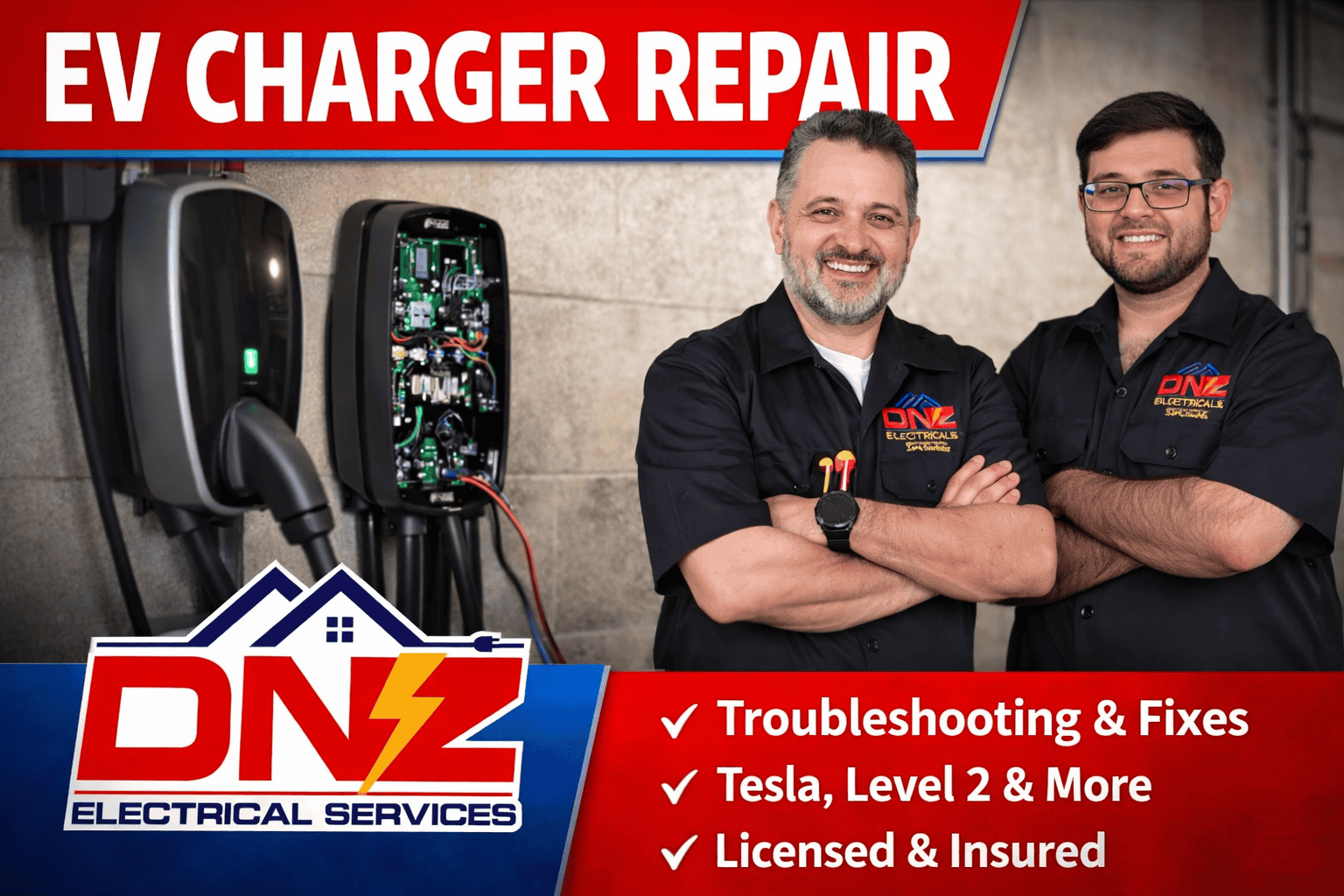
DNZ Electrical Services diagnoses and repairs home EV chargers throughout Thousand Oaks, Agoura Hills, Calabasas, Westlake Village, Moorpark, and all of LA and Ventura County. We are EVITP certified and Tesla Wall Connector certified. When a DIY reset does not fix the problem, the issue is almost always electrical — wiring, breaker, or panel — and that requires a licensed electrician with EV charger experience. Check our EV Charger Installation Page
Try these steps before calling an electrician
About 20% of EV charger problems can be resolved without a service call. Try these steps first — in order. If none of them fix the issue, the problem is electrical and requires a licensed electrician.
Step 1 — Reset your EV charger
Go to your electrical panel and flip the breaker for your EV charger circuit off. Wait 2 full minutes — not 30 seconds. Flip it back on. Allow the charger to fully reboot before plugging in. This clears firmware glitches that cause many intermittent charging failures. If the breaker immediately trips again when you turn it back on, stop — the problem is electrical and you should call 818-514-1417.
Step 2 — Check the breaker itself
A breaker that is in the ON position but neither fully ON nor fully OFF has tripped and needs to be reset. Push it firmly all the way to OFF first — you should feel a click — then push it back to ON. If it trips again within minutes of starting to charge, the breaker is either failing or the circuit is overloaded. A worn breaker that buzzes or feels warm to the touch needs to be replaced by a licensed electrician.
Step 3 — Check for a GFCI conflict
Many Level 2 chargers — including ChargePoint Home Flex, JuiceBox, and Emporia — have built-in GFCI protection (called CCID). If your dedicated EV charger circuit also has a GFCI breaker in the panel, the two GFCI devices can conflict and cause nuisance tripping. ChargePoint specifically advises against using a GFCI breaker with the Home Flex. If you have a GFCI breaker on your EV charger circuit, replacing it with a standard breaker often resolves repeated tripping. Call 818-514-1417 for a diagnosis.
Step 4 — Inspect the cable and connector
Visually inspect the charging cable from the charger to the connector. Look for fraying, kinking, or visible damage. Inspect the connector pins — they should be clean and straight. If pins are bent, corroded, or dirty, the cable needs to be replaced. Do not attempt to repair a damaged charging cable — replacement is the only safe option.
Step 5 — Check for firmware and app updates
Many smart Level 2 chargers — ChargePoint, JuiceBox, Emporia, Tesla Wall Connector — update their firmware automatically over WiFi. If your charger lost WiFi connectivity, it may be running outdated firmware that is causing communication errors with your vehicle. Check your charger's app for any pending updates or error notifications.
Step 6 — Test on a different circuit or public charger
If your charger works at a public Level 2 station but not at home, the problem is with your home's electrical circuit — not the charger or the vehicle. If your charger fails at public stations too, the problem may be with the vehicle's onboard charging system — contact your vehicle dealer. If the charger works at home on Level 1 but not on Level 2, the problem is with the dedicated 240V circuit. Call 818-514-1417.
⚠️ Do NOT open or attempt to repair the internal components of your EV charger. EV chargers operate at 240 volts with significant amperage — internal servicing without proper training and equipment is dangerous. Call DNZ at 818-514-1417.
What is causing your EV charger problem
When the basic reset steps above do not fix the issue, the cause is almost always one of the following. Here is what each problem means and what DNZ does to fix it:
Problem 1 — Breaker trips every time you charge
This is the most common EV charger repair call DNZ receives in Thousand Oaks and Agoura Hills. Three causes account for 95% of cases:
- Wrong breaker size — The breaker must be rated at 125% of the charger's continuous load. A 48-amp charger requires a 60-amp breaker, not a 50-amp breaker. If the original installation used the wrong size, the breaker will trip every charge cycle. DNZ identifies this immediately on the assessment visit and replaces the breaker with the correct size.
- Worn or failing breaker — Breakers wear out over time, especially on circuits with high continuous loads like EV chargers. A breaker that buzzes, feels warm, or trips inconsistently is failing and needs replacement. This is a $50 to $150 fix in most cases.
- Undersized wire gauge — Wire gauge must be matched to the amperage and run length. A 48-amp charger on a 60-amp circuit with 10-gauge wire instead of 6-gauge wire will overheat the wire and trip the breaker or breaker protector. DNZ checks wire gauge on every assessment and flags any undersizing.
Call 818-514-1417. DNZ diagnoses the exact cause on the same-day assessment visit and gives you a firm price to fix it before any work starts.

Problem 2 — Charger not starting or not communicating with vehicle
When the charger appears to power on but the vehicle does not recognize it or charging does not begin, the most common causes are:
- Faulty pilot signal — Level 2 chargers communicate with the vehicle through a low-voltage pilot signal. If that signal is disrupted by a failing charger component or loose wiring connection, the vehicle will not accept the charge. This requires a licensed electrician with EV charger diagnostic equipment to identify.
- Loose wiring connection — A connection that was not fully seated during original installation may work initially but loosen over time due to thermal cycling. DNZ inspects all wiring connections at the charger and at the panel on every assessment visit.
- Failed charger hardware — If the charger unit itself has failed, replacement is needed. DNZ diagnoses whether the fault is in the wiring or in the unit itself before recommending replacement.
Problem 3 — EV charger stopped working after a power outage
Power outages — especially those with voltage spikes during restoration — can damage EV charger electronics. After a power outage:
- Reset the breaker as described in Step 1 above
- Allow the charger 5 full minutes to reboot
- If the charger does not reconnect to your vehicle or shows error lights, the internal electronics may have been damaged by the surge
A surge-damaged EV charger typically needs to be replaced — the internal GFCI and control board are most commonly affected. DNZ diagnoses whether the charger can be restored or needs replacement and installs the new unit if needed. Call 818-514-1417.
Problem 4 — Charging speed dropped significantly
If your charger was adding 30+ miles per hour and now adds only 5 to 10 miles per hour, the most common causes are:
- Charger amperage was reset to a lower setting — Many smart chargers reduce their output amperage after a firmware update or power cycle. Check your charger's app and verify the amperage is set to the maximum your circuit supports.
- Voltage drop on the circuit — Loose connections at the panel or at the charger cause voltage to drop under load, reducing charging speed. DNZ tests voltage at both ends of the circuit and identifies any drop.
- Vehicle charge scheduling — Many EVs have built-in charge scheduling that limits charging rate during peak hours or at certain times. Check your vehicle's charging settings before calling.
Call 818-514-1417 if adjusting the charger app settings does not restore normal charging speed.
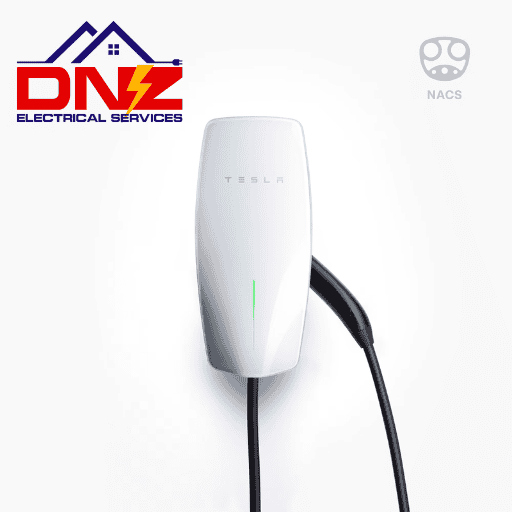
Problem 5 — Tesla Wall Connector not charging or showing error
The Tesla Wall Connector has a built-in LED status indicator that communicates specific fault conditions through light patterns:
- Solid red — Internal fault in the Wall Connector. Reset the breaker and allow 5 minutes to reboot. If the red light persists, the unit likely needs replacement.
- Blinking red — Ground fault detected. This is a wiring or grounding issue that requires a licensed electrician. Call 818-514-1417 immediately — do not ignore a ground fault warning.
- White light blinking slowly — Wall Connector is not commissioned. Needs WiFi setup through the Tesla app. DNZ can complete commissioning as part of the service call.
- No light at all — No power to the Wall Connector. Check the dedicated breaker first. If the breaker is on and the unit has no light, the wiring connection at the Wall Connector may have failed.
DNZ is a Tesla Wall Connector certified installer and can diagnose, repair, or replace a Wall Connector that is not working. Call 818-514-1417.
Tesla Wall Connector installation and service →
Problem 6 — Charger or outlet getting hot during charging
This is a safety issue. Stop charging immediately if:
- The outlet face or plug connection feels warm or hot to the touch
- You smell burning plastic near the charger or outlet
- The breaker or panel feels warm
- You see discoloration or scorch marks anywhere on the outlet or charger
A hot connection indicates a loose, undersized, or degraded wiring connection that is arcing under load. This is a fire hazard. Do not resume charging until a licensed electrician has inspected the circuit. Call DNZ at 818-514-1417 immediately.
⚠️ A hot charger outlet or connection is a fire hazard. Stop charging immediately and call 818-514-1417. DNZ answers 24 hours a day for electrical safety emergencies.
Problem 7 — Charger was never installed correctly from day one
DNZ regularly receives calls from Thousand Oaks and Agoura Hills homeowners whose EV charger was installed by a general contractor, handyman, or uncertified electrician and has never worked reliably. Common original installation errors include wrong breaker size, wrong wire gauge, missing permit and inspection, double-tapping an existing circuit rather than running a dedicated one, and GFCI breaker conflicts with chargers that have built-in CCID protection. DNZ performs a full installation audit, identifies every code violation and safety issue, and brings the installation up to spec. Call 818-514-1417.
Is Your Panel Ready for an EV Charger or New Appliance?
Not sure if your electrical panel has enough capacitybefore you call? Use our free online panel load calculator. Enter your appliances, select your panelsize, and get an instant answer based on NEC 220.82 residential load calculation methodology -- the same approach licensed electricians use.
Most Conejo Valley homes built before 1987 have 100-amp panels that cannot safely support a Level 2EV charger alongside existing household loads. The calculator tells you in under two minutes whetheryour home is in that category.
Check Your Panel Capacity -- Free Calculator
If the calculator flags a capacity issue, call 818-514-1417. DNZ completes panel upgrades and EV charger installations on the same day in most cases.
When to repair your EV charger vs replace it
Not every EV charger problem requires a full replacement. Here is how DNZ approaches the repair vs replace decision:
Repair is the right call when
- The fault is in the electrical circuit — breaker, wire, connection — not in the charger unit itself
- The charger is less than 3 years old and the internal fault is a known firmware or commissioning issue
- A single component like the breaker or outlet is failing but the rest of the installation is correct
Replacement is the right call when
- The charger unit itself has failed internally — control board, GFCI module, or pilot circuit
- The charger was damaged by a power surge or lightning
- The charger is 7 or more years old and has failed multiple times
- The original installation has fundamental errors that require full rewiring regardless
DNZ Electrical Services diagnoses the exact cause before recommending repair or replacement. We do not recommend replacement when repair is the right answer, and we do not spend time on repair attempts when the unit has clearly failed. You get a straight answer and a firm price on the assessment visit.
Why Thousand Oaks and Agoura Hills homeowners call DNZ for EV charger repair
- EVITP certified — the EV-specific credential that covers EV charger diagnostics, wiring requirements, and circuit specifications
- Tesla Wall Connector certified — qualified to diagnose and repair Tesla Wall Connector installations specifically
- 23 years and hundreds of EV charger installations in the Conejo Valley — we have seen every failure mode
- Same-day assessment available for most Thousand Oaks and Agoura Hills addresses
- $85 assessment fee waived when we do the repair — you only pay for the fix, not the diagnosis
- California contractor license B and C10, number 1010883 — licensed for all residential electrical work
- BBB A+ accredited — 522 Google reviews at 4.8 stars
- Lifetime workmanship warranty on all repair labor
- Firm price before any work starts — no surprise charges
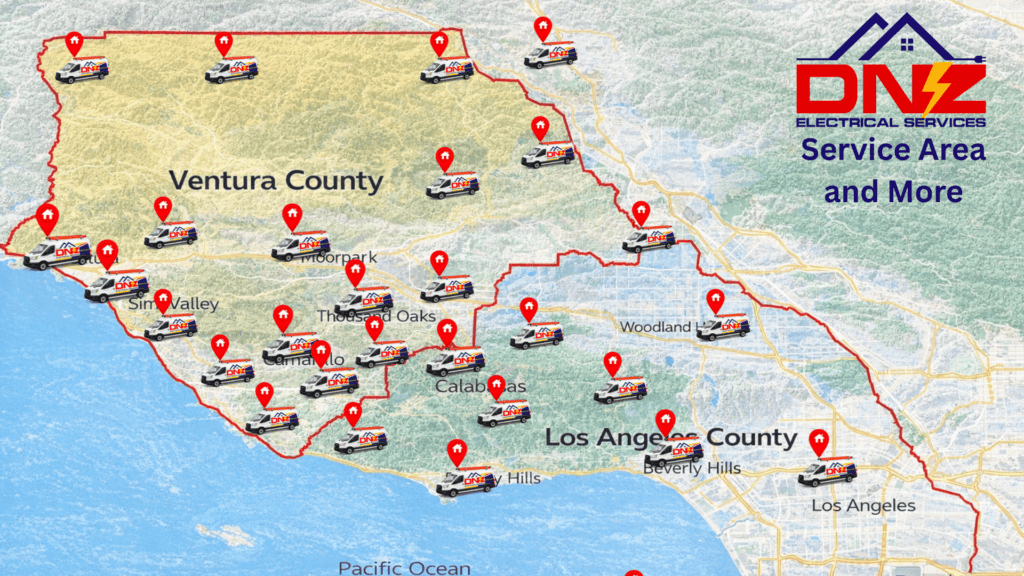
EV charger repair service areas
DNZ provides same-day EV charger repair assessment throughout the following cities from our base at 5627 Kanan Rd, Agoura Hills:
Thousand Oaks · Agoura Hills · Calabasas · Westlake Village · Moorpark · Oak Park · Simi Valley · Camarillo · Ventura · Oxnard · Malibu · Woodland Hills · West Hills · Chatsworth · Northridge · Van Nuys
Questions homeowners ask about EV charger repair
Q: Why does my EV charger keep tripping the breaker?
The three most common causes are wrong breaker size (a 48-amp charger requires a 60-amp breaker, not 50-amp), a worn or failing breaker that can no longer handle the continuous load, and undersized wire gauge for the circuit run length. A GFCI breaker conflicting with the charger's built-in CCID protection is also a common cause — ChargePoint and JuiceBox specifically advise against GFCI breakers on their dedicated circuits. DNZ Electrical Services diagnoses the exact cause on a same-day assessment visit.
Q: My EV charger stopped working after a power outage — what should I do?
First reset the breaker for your EV charger circuit — flip it fully OFF, wait 2 minutes, then back ON. Allow the charger 5 minutes to fully reboot. If the charger still does not work, the power surge during the outage may have damaged the charger's internal electronics. Surge-damaged EV chargers typically need to be replaced. DNZ diagnoses whether repair or replacement is needed and installs the new unit if required. Call 818-514-1417.
Q: My EV charger is charging much slower than it used to — what happened?
Check your charger's app first — many smart chargers reduce their amperage output after a firmware update or power cycle and need to be manually reset to the maximum setting. If the app shows the correct amperage but charging is still slow, the issue is likely a voltage drop caused by a loose wiring connection at the panel or charger. DNZ tests voltage at both ends of the circuit and identifies any drop
Q: My Tesla Wall Connector has a red light — what does it mean?
A solid red light on a Tesla Wall Connector indicates an internal fault — reset the dedicated breaker and allow 5 minutes to reboot. If the red light persists, the unit likely needs replacement. A blinking red light indicates a ground fault — this is a wiring or grounding issue that requires a licensed electrician immediately. Do not ignore a blinking red light on a Wall Connector. DNZ is a Tesla Wall Connector certified installer and can diagnose and resolve Wall Connector issues same day.
Q: My EV charger outlet feels warm — is that normal?
No. A charger outlet or connection that feels warm or hot to the touch is not normal and is a potential fire hazard. A warm connection indicates a loose, undersized, or degraded wiring connection that is arcing under load. Stop charging immediately and call DNZ at 818-514-1417.
Q: Can I repair my EV charger myself?
You can safely perform basic troubleshooting — resetting the breaker, checking for error codes in the app, and visually inspecting the cable. You should never open or attempt to repair the internal components of an EV charger. EV chargers operate at 240 volts with significant amperage — internal servicing without proper training and equipment is dangerous. Any work on the electrical circuit — breaker replacement, wire inspection, connection tightening — requires a licensed electrician.
Q: How quickly can DNZ respond to an EV charger repair call in Thousand Oaks or Agoura Hills?
Same-day assessment is available for most Thousand Oaks and Agoura Hills addresses. DNZ is based at 5627 Kanan Rd, Agoura Hills — we are already in your area. For situations involving a hot outlet, burning smell, or other electrical safety concern, call 818-514-1417 immediately — DNZ answers 24 hours a day for electrical safety calls.
Q: Does DNZ repair all EV charger brands?
Yes. DNZ Electrical Services diagnoses and repairs electrical issues on all Level 2 EV charger installations including Tesla Wall Connector, ChargePoint, JuiceBox, Emporia, Grizzl-E, and all other brands. We are EVITP certified and Tesla Wall Connector certified. For issues that are in the charger hardware rather than the electrical circuit, we advise on replacement options and install the new unit. CA License #1010883. Call 818-514-1417.