
GFCI Outlet Installation & Replacement in Thousand Oaks & Agoura Hills — Licensed, Code-Compliant, and Backed by a Lifetime Warranty
.
4.8 Star Google Rating|23+ Years Experience|10,000+ Homes Served|Licensed CA Contractor #1010883|BBB A+ Accredited
DNZ Electrical Services installs and replaces GFCI outlets throughout Thousand Oaks, Agoura Hills, Calabasas, Westlake Village, Moorpark, and all of LA and Ventura County. We install GFCI outlets in kitchens, bathrooms, garages, outdoor areas, and all other code-required locations. Every installation meets California electrical code, is tested before we leave, and is backed by our lifetime workmanship warranty.
What is a GFCI outlet and what does it do?
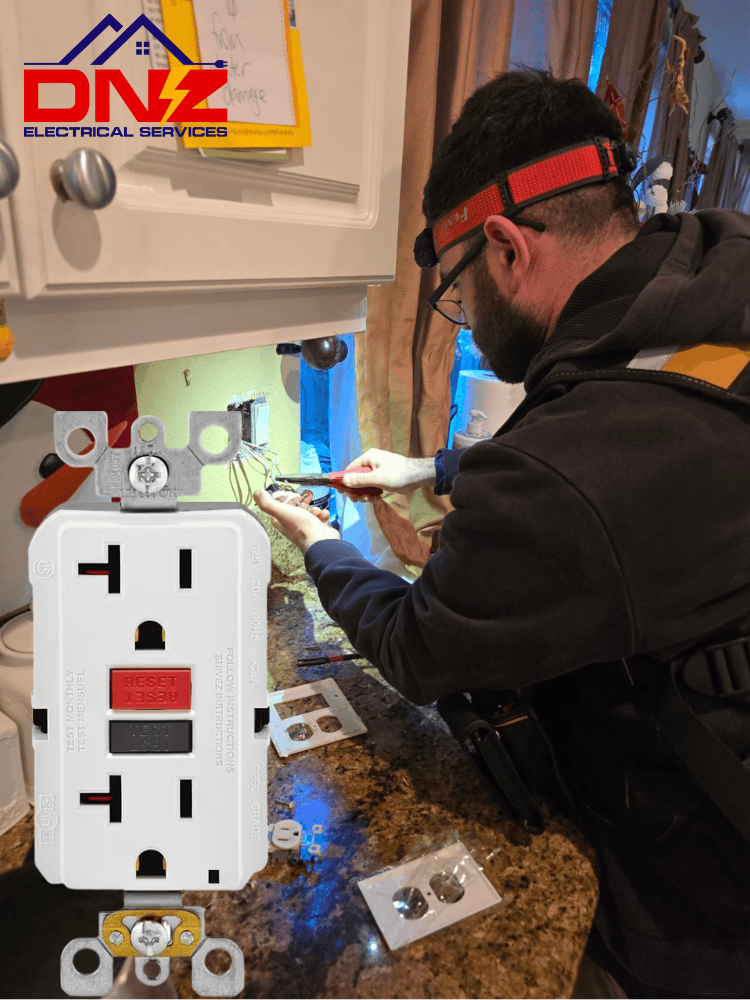
GFCI stands for Ground Fault Circuit Interrupter. It is a type of electrical outlet that monitors the flow of electricity through the circuit and shuts off power within milliseconds if it detects an imbalance. That imbalance is what happens when electricity finds an unintended path to the ground — like through a person's body.
A standard outlet does not do this. It will keep delivering power even when a fault occurs. A GFCI outlet cuts power fast enough to prevent a fatal shock. That is why California code requires them anywhere water and electricity could meet — kitchens, bathrooms, garages, outdoor areas, and more.
You can identify a GFCI outlet by the two small buttons in the center — labeled TEST and RESET. If the outlet trips, pressing RESET restores power. If it won't reset, the GFCI has likely failed and needs to be replaced.
GFI outlet is another common name for the same device — GFI stands for Ground Fault Interrupter. GFCI and GFI refer to the same type of outlet.
✅ A GFCI outlet can cut power in as little as 1/40th of a second — fast enough to prevent electrocution in most cases.
Where GFCI outlets are required in California
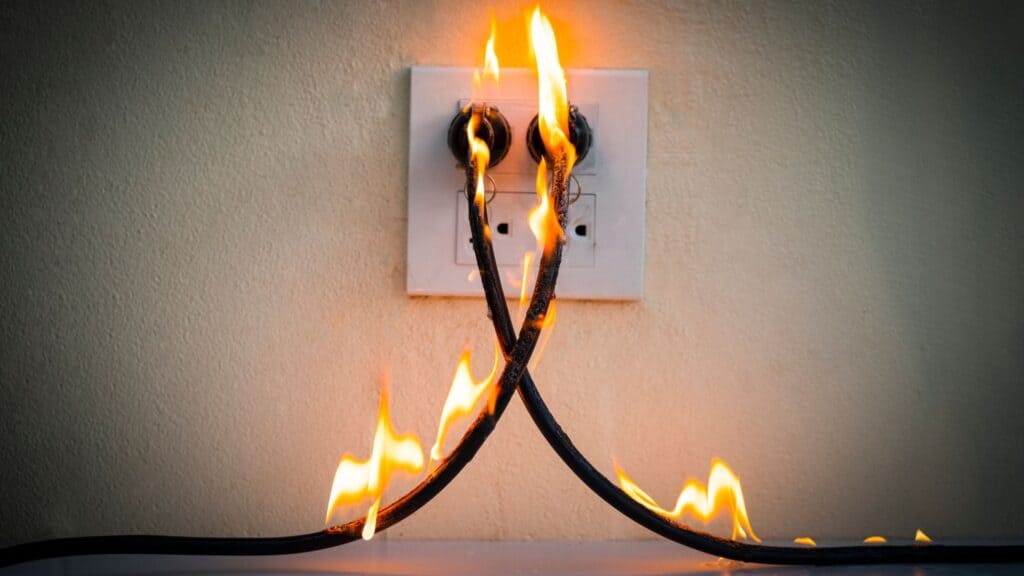
The National Electrical Code (NEC) and California Electrical Code require GFCI protection in specific locations throughout every home. These requirements apply to all new construction and to any electrical work that triggers a permit — including panel upgrades and new outlet installations. If your home was built before these rules were adopted, your existing outlets may be grandfathered in — but a home inspection will flag them, and many lenders require them to be corrected before closing.
Kitchens
All outlets within 6 feet of a kitchen sink must be GFCI protected. This covers countertop outlets near the sink, dishwasher circuits, and any outlet on a countertop surface — even if it's farther from the sink than you'd expect. Most Thousand Oaks homes built before 1987 have standard outlets in these locations.
Garages
All outlets in attached and detached garages must be GFCI protected. This includes outlets on the walls and ceiling of the garage. Many older Agoura Hills and Thousand Oaks garages still have standard outlets — particularly near workbenches and at the garage door opener location.
Crawl spaces and unfinished basements
Any outlet in a crawl space or unfinished basement area must be GFCI protected. Many older homes in the Conejo Valley area have outlets in these locations that were installed before this requirement took effect.
⚠️ Home inspection reports in California routinely flag non-GFCI outlets in kitchens, bathrooms, and garages. If your inspection report has these items, DNZ can correct them the same day in most cases. Call 818-514-1417.
Bathrooms
Every outlet in every bathroom must be GFCI protected — no exceptions. This includes outlets inside vanity drawers, toilet rooms with separate doors, and any outlet within reach of the tub or shower. Bathroom GFCI installation is one of the most common jobs DNZ handles on home inspection repair lists.
Outdoor outlets
Every outdoor outlet must be GFCI protected and installed in a weatherproof box with a weatherproof cover. The National Electrical Code requires weatherproof covers rated for in-use protection — meaning the cover stays closed around a plug that is plugged in. If your outdoor outlet is covered by a standard flip cover that hangs open when a cord is plugged in, it does not meet current code.
Near pools, hot tubs, and water features
Any outlet within 20 feet of a pool, hot tub, spa, or water feature must be GFCI protected. This is one of the most important safety requirements — electricity and water together are a serious hazard. DNZ handles pool and spa area GFCI upgrades throughout Thousand Oaks, Calabasas, and Westlake Village.
 How much does GFCI outlet installation cost in Thousand Oaks or Agoura Hills?

In the Thousand Oaks and Agoura Hills area, GFCI outlet installation typically costs $150 to $300 per outlet for a straightforward replacement. New GFCI outlet installation — where there is no existing outlet and new wiring needs to be run — runs $200 to $400 depending on the length of the wire run and access conditions.
DNZ Electrical Services's service assessment fee is $85 during regular hours. That fee is waived when you move forward with the work. For most GFCI jobs, the service fee is the biggest variable — the outlet hardware itself costs $15 to $40.
What drives the cost up or down
- How many outlets need replacing — the service assessment fee gets spread across more outlets when doing multiple at once, which lowers the per-outlet cost significantly
- Replacing vs adding new — swapping an existing standard outlet for a GFCI is quick. Running new wiring to a location that has no outlet is more work
- Indoor vs outdoor — outdoor GFCI outlets need a weatherproof box and weatherproof in-use cover, which adds material cost
- Access conditions — outlets behind cabinetry, in tight crawl spaces, or in finished walls that require patching cost more
- Whether old wiring needs updating — homes built before 1965 in some areas of Thousand Oaks and Agoura Hills may have wiring that needs updating before a GFCI can be installed correctly
✅ Best value tip: If your home inspection flagged multiple GFCI locations, have DNZ address them all in one visit. You pay one service fee spread across the whole job instead of multiple call-out fees.
solution
Types of GFCI outlets DNZ installs
Standard indoor GFCI outlet — 15-amp or 20-amp
The most common GFCI outlet for kitchens and bathrooms. Available in 15-amp for standard circuits and 20-amp for kitchen countertop circuits. DNZ installs tamper-resistant GFCI outlets as standard — these have a built-in shutter that prevents children from inserting foreign objects.
Outdoor weatherproof GFCI outlet
Outdoor GFCI outlets require a weatherproof electrical box, a weatherproof in-use cover (the kind that covers the plug while a cord is in use), and a GFCI outlet rated for outdoor or damp locations. DNZ installs complete outdoor GFCI setups to current California code including the box, cover, and outlet.
GFCI outlet with USB charging ports
A popular upgrade in kitchens and master bathrooms — a GFCI outlet that includes built-in USB-A or USB-C charging ports. No separate charger plug required. DNZ installs these as a direct replacement for standard GFCI outlets with no additional wiring needed.
GFCI circuit breaker — protects an entire circuit
Instead of replacing every outlet on a circuit with individual GFCI outlets, a GFCI circuit breaker installed in the electrical panel protects every outlet on that circuit. This is often more cost-effective when an older home needs GFCI protection throughout multiple locations on the same circuit. DNZ assesses which approach makes more sense for your specific situation.

Contact Us
By clicking "Submit", you agree to DNZ Electrical Services Terms of Use and Privacy Policy. You consent to receive phone calls and SMS messages from DNZ Electrical Services to provide updates on your order and/or for marketing purposes. Message frequency depends on your activity. You may opt-out by texting "STOP". Message and data rates may apply.
We offer financing
We’ve partnered with Wisetack to offer our customers flexible financing options, so you can pay over time rather than all at once. The application takes about a minute to complete, and checking your options does not impact your credit score.
Finance projects up to $25,000*
Terms from 3 to 120 months*
APRs from 0 to 35.9%*
No hidden fees or compounding interest
Prequalify today with no impact to your credit and contact us to learn about financing your next project!
*All financing is subject to credit approval. Your terms may vary. Payment options through Wisetack are provided by our lending partners. For example, a $1,200 purchase could cost $104.89 a month for 12 months, based on an 8.9% APR, or $400 a month for 3 months, based on a 0% APR. Offers range from 0-35.9% APR based on creditworthiness. State interest rate caps may apply. No other financing charges or participation fees. See additional terms at https://wisetack.com/faqs
What happens during a DNZ GFCI outlet installation

What to expect when DNZ installs a GFCI outlet
- Call 818-514-1417 or book online — we schedule a same-day or next-day visit
- Our licensed electrician assesses your existing outlets, checks the wiring condition, and identifies all locations that need GFCI protection
- We give you a firm price before any work starts — no surprises
- We install the GFCI outlets, test each one with the TEST and RESET buttons, and verify power is restored correctly
- We check that all outdoor outlets have proper weatherproof in-use covers
- We leave the area clean — no drywall holes, no mess
- Every outlet installed comes with our lifetime workmanship warranty
Most GFCI replacement jobs — even homes with multiple flagged locations — are complete in one visit in 1 to 3 hours. Call 818-514-1417 for a same-day assessment.
Cities we serve
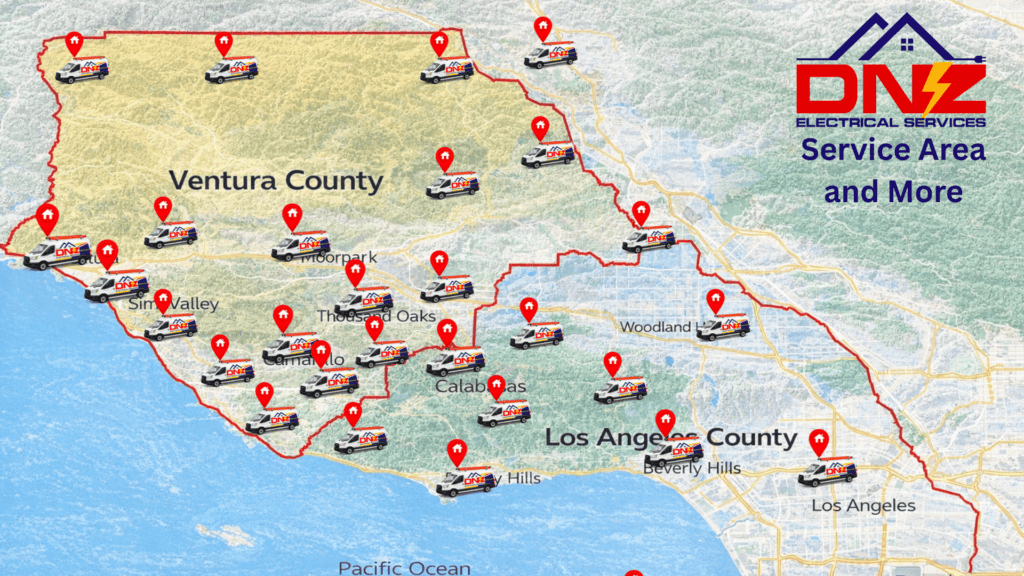
Our shop is at 5627 Kanan Rd, Agoura Hills — right in the middle of the Conejo Valley. We cover most of LA County and Ventura County, including the cities below
- Thousand Oaks
- Agoura Hills
- Calabasas
- Westlake Village
- Moorpark
- Oak Park
- Simi Valley
- Van Nuys
- Canoga Park
- Camarillo
- Ventura
- Oxnard
- Malibu
- Woodland Hills
- West Hills
- Chatsworth
- Northridge
- Encino
Not sure if we cover your area? Check our Service Area Page or Call or Text 818-514-1417. We'll tell you straight
Trusted by Homeowners Across Agoura Hills, Thousand Oaks & the Conejo Valley
Questions homeowners ask about GFCI outlets
Q: How much does GFCI outlet installation cost in Thousand Oaks or Agoura Hills Electrician ?
In the Thousand Oaks and Agoura Hills area, replacing a standard outlet with a GFCI outlet typically costs $150 to $300 per outlet including labor. New GFCI outlet installation where wiring needs to be run runs $200 to $400. DNZ's service assessment fee is $85, waived when you move forward with the work. Multiple outlets done in one visit cost less per outlet since the service fee is spread across the whole job. Call 818-514-1417.
Q: How long does GFCI outlet installation take?
Replacing a single existing outlet with a GFCI takes about 15 to 30 minutes. A full home inspection GFCI repair visit covering multiple outlets in kitchens, bathrooms, and garages typically takes 1 to 3 hours. DNZ handles most GFCI jobs in a single visit with no return trips needed.
Q: Do I need a permit to install a GFCI outlet?
For a direct like-for-like replacement of an existing outlet with a GFCI outlet, a permit is generally not required. For new outlet installation — where a new circuit or new wiring needs to be run — a permit is required. DNZ will tell you which applies to your specific job before starting and handles all permit paperwork when a permit is needed.
Q: Why won't my GFCI outlet reset?
A GFCI that won't reset has either detected a fault in the wiring or connected device, or the GFCI itself has failed. First try unplugging everything from the outlet and any outlets connected to it on the same circuit, then press RESET. If it still won't reset, the GFCI needs to be replaced. If it resets but trips again when you plug something in, the problem is the appliance. If it resets but has no power, call DNZ at 818-514-1417 — the issue may be upstream in the wiring.
Q: My GFCI outlet has power but the TEST button doesn't work — is that a problem?
Yes. A GFCI outlet that delivers power but doesn't trip when you press the TEST button has failed as a safety device. It is still passing electricity but it has lost its ability to detect a ground fault and cut power. This means it will not protect you from electrocution. Replace it. DNZ can replace a failed GFCI outlet same day — call 818-514-1417.
Q: How often should I test my GFCI outlets?
Monthly. Press the TEST button on each GFCI outlet in your home — it should cause the outlet to lose power. Then press RESET to restore power. If either function fails, the GFCI needs to be replaced. Bathroom and outdoor GFCI outlets wear out faster due to moisture and should be replaced every 7 to 10 years even if they test correctly.
Q: Does my home need GFCI outlets?
If your home was built or had electrical work done after 1973, some GFCI outlets may already be in place. If your home is older or has never had the outlets upgraded, kitchens, bathrooms, garages, and outdoor areas likely still have standard outlets that do not meet current California code. A home inspection will flag these. DNZ can assess your home and identify every location that needs GFCI protection. Call 818-514-1417.
Q: What is the difference between a GFCI outlet and an AFCI breaker?
A GFCI outlet protects against ground faults — the kind of electrical fault that causes electrocution, particularly near water. An AFCI (Arc Fault Circuit Interrupter) breaker protects against arc faults — the kind that cause electrical fires from damaged or deteriorated wiring. They protect against different hazards and are required in different locations. GFCI is required near water. AFCI is required in bedrooms and living areas. Many modern installations use dual-function AFCI/GFCI breakers. DNZ installs both.