
How Much Does It Cost to Charge an EV at Home in 2026? Real Numbers for SCE Customers in Thousand Oaks, Agoura Hills, and Ventura County
At the standard SCE residential rate of 34.5 cents per kWh, charging a Tesla Model Y Long Range at home costs approximately $12 to $15 for a full charge from 20% adding roughly 280 miles of range. That works out to about 4.5 cents per mile. A typical Conejo Valley driver covering 1,000 miles per month pays $45 in charging electricity. Check Our EV charger installation services for more information on EV Charger Installtion and costs.
If you switch to SCE's TOU-D-PRIME rate plan for EV owners and charge during off-peak hours — 8am to 4pm or after 9pm — the cost drops significantly. SCE specifically notes that charging an EV during off-peak TOU-D-PRIME hours is roughly equivalent to a gas driver paying less than $2 per gallon. At current gas prices in Thousand Oaks of around $4.50 per gallon, that is more than a 55% fuel cost savings.
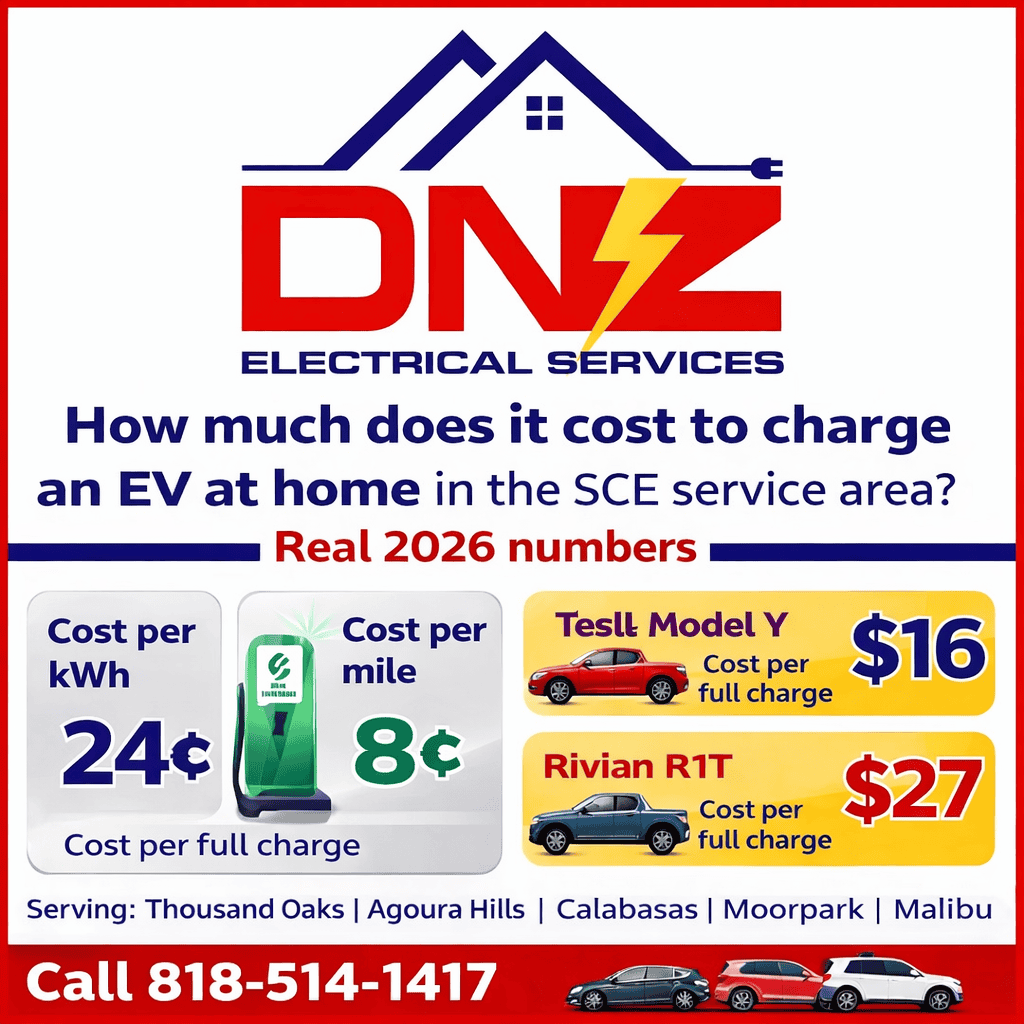
SCE electricity rates for EV charging in 2026
Southern California Edison serves all of Thousand Oaks, Agoura Hills, Calabasas, Westlake Village, Moorpark, and Malibu. As of January 1, 2026, the SCE average residential rate is 34.5 cents per kWh. However, EV owners have access to a dedicated rate plan that significantly reduces the cost of overnight charging.
Standard SCE rate — TOU-D-4-9PM (most residential customers)
Off-peak rate (9pm to 4pm next day): Approximately 25 to 30 cents per kWh
On-peak rate (4pm to 9pm): Approximately 55 to 60 cents per kWh — weekdays
Weekend rate: Off-peak rate all day on weekends
EV charging recommendation: Never charge 4pm to 9pm on weekdays — always schedule overnight
Most SCE customers are on the TOU-D-4-9PM plan. If you charge your EV during the on-peak window of 4pm to 9pm on weekdays, you are paying two to three times more per kWh than necessary. Setting your car or charger to start charging at 9pm or later — and finish before 4pm the next day — dramatically reduces charging cost on this plan.
SCE TOU-D-PRIME — the dedicated EV owner rate plan
Who qualifies: Any SCE customer who attests to owning an EV, home battery, or heat pump
Base service charge: $0.79 per day ($23.70 per month fixed)
Off-peak rate (9pm to 8am + weekends): Approximately 24 to 27 cents per kWh — the lowest SCE residential rate
On-peak rate (4pm to 9pm weekdays): Higher than standard plans — avoid at all costs
Best charging window: 9pm to 8am — charge overnight, unplug or stop before 4pm
Equivalent gas price: Less than $2 per gallon when charging off-peak
TOU-D-PRIME trades a higher fixed daily base charge for lower per-kWh rates during off-peak hours. For EV owners who charge primarily overnight, this trade-off typically results in lower total monthly electricity costs compared to the standard TOU plan. The key is strict avoidance of on-peak charging — if you regularly charge during 4pm to 9pm on this plan, your bill will be higher than on the standard rate.
💡 HOW TO SWITCH TO TOU-D-PRIME: Log in to sce.com and navigate to Rate Plans. Select TOU-D-PRIME and attest that you own an EV. No inspection or equipment change is required. The switch typically takes effect on your next billing cycle. No cost to switch.
How much does it cost to charge each EV at home? 2026 SCE rates
All calculations below use two rates: 34.5 cents per kWh (SCE average residential rate as of January 2026) and 26 cents per kWh (estimated SCE TOU-D-PRIME off-peak rate, charging 9pm to 8am). Charging from 20% to 100% of battery capacity. Consult your specific vehicle's onboard charger efficiency for precise numbers.
Tesla Model Y Long Range : 82 kWh usable battery
Cost for full charge — standard SCE rate (34.5 cents): Approximately $20.50
Cost for full charge — TOU-D-PRIME off-peak (26 cents): Approximately $15.50
Range per full charge: 330 miles
Cost per mile — standard rate: Approximately 6.2 cents per mile
Cost per mile — TOU-D-PRIME off-peak: Approximately 4.7 cents per mile
Monthly cost — 1,000 miles — standard rate: Approximately $62
Monthly cost — 1,000 miles — TOU-D-PRIME off-peak: Approximately $47
Tesla Model Y Standard Range — 60 kWh usable battery
Cost for full charge — standard rate: Approximately $15
Cost for full charge — TOU-D-PRIME off-peak: Approximately $11.40
Range per full charge: 260 miles
Cost per mile — standard rate: Approximately 5.8 cents
Cost per mile — TOU-D-PRIME off-peak: Approximately 4.4 cents
Tesla Model 3 Long Range :82 kWh usable battery
Cost for full charge — standard rate: Approximately $20.50
Cost for full charge — TOU-D-PRIME off-peak: Approximately $15.50
Range per full charge: 358 miles
Cost per mile — standard rate: Approximately 5.7 cents
Cost per mile — TOU-D-PRIME off-peak: Approximately 4.3 cents
Rivian R1T / R1S Large Pack — 135 kWh usable battery
Cost for full charge — standard rate: Approximately $33.75
Cost for full charge — TOU-D-PRIME off-peak: Approximately $25.50
Range per full charge: 314 miles
Cost per mile — standard rate: Approximately 10.7 cents
Cost per mile — TOU-D-PRIME off-peak: Approximately 8.1 cents
Ford F-150 Lightning Extended Range — 131 kWh usable battery
Cost for full charge — standard rate: Approximately $32.75
Cost for full charge — TOU-D-PRIME off-peak: Approximately $24.75
Range per full charge: 320 miles
Cost per mile — standard rate: Approximately 10.2 cents
Cost per mile — TOU-D-PRIME off-peak: Approximately 7.7 cents
Rivian R1T / R1S Large Pack — 135 kWh usable battery
Cost for full charge — standard rate: Approximately $33.75
Cost for full charge — TOU-D-PRIME off-peak: Approximately $25.50
Range per full charge: 314 miles
Cost per mile — standard rate: Approximately 10.7 cents
Cost per mile — TOU-D-PRIME off-peak: Approximately 8.1 cents
BMW iX xDrive50 — 105.2 kWh usable battery
Cost for full charge — standard rate: Approximately $26.30
Cost for full charge — TOU-D-PRIME off-peak: Approximately $19.85
Range per full charge: 324 miles
Cost per mile — standard rate: Approximately 8.1 cents
Cost per mile — TOU-D-PRIME off-peak: Approximately 6.1 cents
Lucid Air Pure — 88 kWh usable battery
Cost for full charge — standard rate: Approximately $22
Cost for full charge — TOU-D-PRIME off-peak: Approximately $16.60
Range per full charge: 410 miles
Cost per mile — standard rate: Approximately 5.4 cents
Cost per mile — TOU-D-PRIME off-peak: Approximately 4.0 cents
EV vs gas — how much do you actually save on fuel in the Conejo Valley?
Gas prices in Thousand Oaks and the Conejo Valley typically run $4.20 to $4.80 per gallon in 2026. Using $4.50 as the mid-range figure, here is what a typical Conejo Valley driver saves by switching from a 30-MPG gas vehicle to an EV charged at home on TOU-D-PRIME off-peak rates:
For a driver covering 1,000 miles per month
Gas vehicle at 30 MPG and $4.50 per gallon: $150 per month in fuel
EV on standard SCE rate (34.5 cents per kWh): $57 to $107 per month depending on vehicle
EV on TOU-D-PRIME off-peak (26 cents per kWh): $40 to $81 per month depending on vehicle
Monthly savings vs gas — standard rate: $43 to $93 per month
Monthly savings vs gas — TOU-D-PRIME off-peak: $69 to $110 per month
Annual savings vs gas — TOU-D-PRIME off-peak: $828 to $1,320 per year
For a driver covering 1,500 miles per month
Gas vehicle at 30 MPG and $4.50 per gallon: $225 per month in fuel
EV on TOU-D-PRIME off-peak: $60 to $122 per month depending on vehicle
Monthly savings vs gas — TOU-D-PRIME off-peak: $103 to $165 per month
Annual savings vs gas — TOU-D-PRIME off-peak: $1,236 to $1,980 per year
Two-EV Conejo Valley household — 2,500 miles per month combined
Two gas vehicles at 30 MPG and $4.50 per gallon: $375 per month in fuel
Two EVs on TOU-D-PRIME off-peak: $100 to $200 per month depending on vehicles
Monthly savings vs two gas vehicles: $175 to $275 per month
Annual savings: $2,100 to $3,300 per year
✅ A Conejo Valley household with two EVs charging at home on TOU-D-PRIME off-peak rates saves $2,100 to $3,300 per year in fuel costs compared to two 30-MPG gas vehicles at $4.50 per gallon. That savings pays back the cost of a Level 2 home charger installation in under 12 months in most cases.
Does Level 1 or Level 2 charging affect how much you pay?
The rate you pay per kWh is the same regardless of whether you use Level 1 or Level 2 charging — SCE charges you by the kilowatt-hour, not by the charging method. But Level 1 and Level 2 charging have very different implications for how much you can shift your charging into off-peak windows.
Level 1 — Standard 120V outlet — 4 to 5 miles per hour
Level 1 charging adds 4 to 5 miles per hour. A Tesla Model Y Long Range with an 82 kWh battery needs approximately 65 hours to charge from 20% to 100% at Level 1. That means a full charge requires more than two full days of continuous charging. You cannot reliably charge your vehicle every night and have it full by morning at Level 1 unless your daily driving is very limited — under 30 to 40 miles.
The deeper problem for cost optimization is that Level 1 charging cannot be precisely timed to the off-peak window. If you plug in at 9pm and need your car at 7am — that is 10 hours. Level 1 adds approximately 45 to 50 miles in 10 hours. If your daily driving exceeds that, you carry a deficit into the next night. You cannot consistently stay inside the off-peak window with Level 1 if you drive more than 40 to 50 miles daily.
Level 2 — 240V dedicated circuit — 20 to 44 miles per hour
Level 2 charging adds 20 to 44 miles per hour depending on the charger amperage and your vehicle's onboard charger. A Tesla Model Y Long Range charges from 20% to 100% in approximately 7 to 8 hours at 48 amps. Plug in at 9pm. Fully charged by 5am. Car is ready. You used 7 to 8 hours of off-peak electricity at 26 cents per kWh. Total cost: approximately $15.50.
With Level 2, you can drive 300+ miles per day and still fully recharge overnight in the off-peak window every single night. You never carry a deficit. You always wake up with a full battery. And because you can completely recharge within the off-peak window, you capture every dollar of savings from the TOU-D-PRIME rate plan.
✅ Level 1 charging leaves most EV owners unable to capture TOU-D-PRIME off-peak savings because they cannot complete a full charge within the overnight window. Level 2 charging solves this completely. The cost of a Level 2 installation — $800 to $2,100 — is recovered in rate savings within 12 to 18 months for most Conejo Valley drivers.
How to always charge your EV at the lowest possible SCE rate
For SCE customers on TOU-D-4-9PM or TOU-D-PRIME, the off-peak charging strategy is the same: never charge between 4pm and 9pm on weekdays. Here is how to execute this automatically so you never have to think about it:
Option 1 — Set your vehicle's scheduled departure time
Every major EV — Tesla, Rivian, Ford, Hyundai, BMW, Chevy — has a scheduled charging feature in the vehicle app or onboard settings. Set your departure time to 7am or 8am. The vehicle calculates backwards to start charging at the optimal time to be fully charged by departure — typically starting after 9pm. This is the simplest approach and works with any outlet or charger.
Option 2 — Set your charger's schedule through the app
Level 2 smart chargers — ChargePoint, JuiceBox, Emporia, and Tesla Wall Connector — all have scheduling features in their companion apps. Set the start time to 9pm or later and the stop time to 7am or 8am. The charger handles the rest. This is the most reliable approach because the charger controls when power flows rather than relying on the vehicle.
Option 3 — Enroll in SCE's EV Charging Rewards program
SCE offers an EV Charging Rewards program that automatically manages your charging to avoid peak hours in exchange for a monthly bill credit. Contact SCE at sce.com to check current enrollment options and credit amounts. This program works best for drivers with flexible schedules who do not need guaranteed charging completion by a specific time.
⚠️ NEVER rely on Level 1 charging alone to stay within the off-peak window if you drive more than 40 miles per day. Level 1 charges too slowly to complete in one overnight off-peak window for most EV drivers. Level 2 charging is the only way to reliably capture all available off-peak rate savings.
Does a Level 2 charger increase your electricity bill?
A Level 2 charger does not change how much electricity your EV uses — your car's battery capacity is fixed. What changes is how quickly the energy transfers and whether you can reliably fit all your charging into the off-peak window. However, there are two additional costs worth knowing:
The TOU-D-PRIME base service charge — $23.70 per month
If you switch to TOU-D-PRIME to get the lowest off-peak EV charging rates, you pay a fixed base service charge of $0.79 per day — approximately $23.70 per month. This replaces the baseline credit you receive on other plans. For EV owners who charge frequently, the lower per-kWh rate more than offsets this fixed charge. For households that charge infrequently, it may not.
Simple break-even calculation: If TOU-D-PRIME saves you 8 cents per kWh compared to your current plan's off-peak rate, you need to charge at least 297 kWh per month for the savings to exceed the $23.70 base charge. A Tesla Model Y Long Range driving 1,000 miles per month uses approximately 286 kWh — very close to break-even. At 1,100 miles per month you are solidly in the money on TOU-D-PRIME.
The Level 2 charger installation cost — a one-time investment
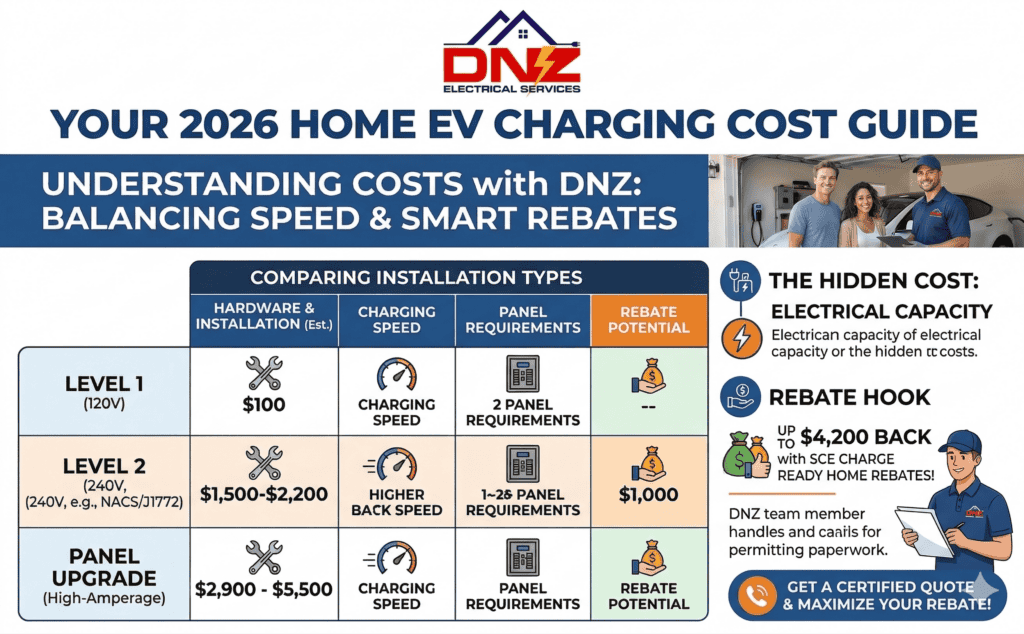
A Level 2 home charger installation costs $800 to $2,100 total including hardware, labor, and permit fees for a standard attached garage install. This is a one-time cost. At savings of $50 to $100 per month in fuel versus gas — which is typical for a Conejo Valley driver covering 1,000 to 1,500 miles monthly — the installation pays back in 10 to 24 months. After payback, the savings are pure monthly benefit, compounding as gas prices continue to rise.
✅ PAYBACK EXAMPLE: A Thousand Oaks homeowner installs a Level 2 charger for $1,400 total. They switch to TOU-D-PRIME. Their monthly fuel cost drops from $180 in gas to $112 in electricity including the base charge — a saving of $68 per month. Payback on the charger: 1,400 ÷ 68 = 20.6 months. After that, $68 per month stays in their pocket every month for the life of the vehicle.
EV charger installation across LA and Ventura County
DNZ Electrical Services installs home EV chargers throughout the following cities. Our shop is at 5627 Kanan Rd, Agoura Hills — central to the Conejo Valley and Ventura County.
Thousand Oaks | Agoura Hills | Calabasas | Westlake Village | Moorpark | Oak Park | Simi Valley | Camarillo | Ventura | Oxnard | Malibu | Woodland Hills | West Hills | Chatsworth | Northridge | Van Nuys | Canoga Park
Check Our Service Area Page for additional city coverages.
EV charger installation in Thousand Oaks
DNZ Electrical Services installs Level 2 home EV chargers throughout Thousand Oaks, CA. We are EVITP certified and Tesla Wall Connector certified. We work with the City of Thousand Oaks permit office and pull all required permits for EV charger installations. Most Thousand Oaks EV charger installs cost $900 to $2,500 in labor and permit fees and take 2 to 4 hours. Call 818-514-1417 for a same-day assessment.
EV charger installation in Agoura Hills
DNZ is based in Agoura Hills at 5627 Kanan Rd Suite 200. We have been installing EV chargers in Agoura Hills since the technology became mainstream for residential use. We know the local permit process and SCE coordination requirements for this area. California license B and C10, number 1010883.
EV charger installation in Calabasas, Westlake Village, and Moorpark
DNZ Electrical Services installs home EV chargers in Calabasas, Westlake Village, Moorpark, and surrounding cities. We handle permits, SCE coordination, and city inspections for all installations. Call 818-514-1417 or Contact Us to schedule.
Frequently asked questions about EV home charging costs
Q: How much does it cost to charge a Tesla Model Y at home in the SCE service area?
At the SCE average residential rate of 34.5 cents per kWh as of January 2026, charging a Tesla Model Y Long Range from 20% to 100% costs approximately $20.50. At the SCE TOU-D-PRIME off-peak rate of approximately 26 cents per kWh, the same full charge costs approximately $15.50. Charging 1,000 miles per month on TOU-D-PRIME off-peak costs approximately $47 in electricity. For context, driving 1,000 miles per month in a 30-MPG gas vehicle at $4.50 per gallon costs $150 in fuel. The EV saves approximately $103 per month in fuel costs versus a gas vehicle on TOU-D-PRIME off-peak. DNZ Electrical Services installs Level 2 home EV chargers throughout Thousand Oaks, Agoura Hills, and all of LA and Ventura County. CA License #1010883.
Q: What is the SCE TOU-D-PRIME rate plan and should I switch to it as an EV owner?
SCE TOU-D-PRIME is a time-of-use rate plan specifically designed for customers with EVs, home batteries, or heat pumps. It offers the lowest SCE residential per-kWh rates during off-peak hours — approximately 24 to 27 cents per kWh when charging between 9pm and 8am. The plan has a higher fixed base service charge of $0.79 per day ($23.70 per month) compared to standard plans but lower per-kWh rates. SCE notes that charging an EV on TOU-D-PRIME during off-peak hours is roughly equivalent to a gas driver paying less than $2 per gallon. For EV owners charging 1,100 or more miles per month at home, TOU-D-PRIME typically results in lower total monthly electricity costs. To enroll, log in to sce.com and switch your rate plan. No equipment change is required.
Q: What is the SCE residential electricity rate in 2026?
The SCE average residential electricity rate as of January 1, 2026 is 34.5 cents per kWh (33.2 cents per kWh with the California Climate Credit applied in April and October). SCE rates vary significantly based on your rate plan and time of day — off-peak rates on TOU plans run approximately 24 to 30 cents per kWh while on-peak rates during the 4pm to 9pm window can reach 55 to 74 cents per kWh. Always verify your current rate on your SCE bill or at sce.com as rates are updated periodically.
Q: Is it cheaper to use Level 1 or Level 2 charging at home?
The cost per kWh is identical — SCE charges the same rate regardless of whether you use a Level 1 or Level 2 charger. What differs is your ability to time your charging within the cheapest off-peak window. Level 1 charges at 4 to 5 miles per hour. Level 2 charges at 20 to 44 miles per hour. If you drive more than 40 to 50 miles per day, Level 1 cannot complete a full charge within the overnight off-peak window. Level 2 can complete a full charge for most EVs in 7 to 10 hours overnight. This means Level 2 enables you to capture all available off-peak rate savings every night. Level 1 cannot for most drivers. DNZ Electrical Services installs Level 2 home EV chargers throughout the Conejo Valley. CA License #1010883. Call 818-514-1417.
Q: How much does it cost per mile to charge an EV at home vs buying gas in Thousand Oaks?
At the SCE TOU-D-PRIME off-peak rate of approximately 26 cents per kWh, most EVs cost 4 to 8 cents per mile in electricity depending on the vehicle's efficiency. At $4.50 per gallon gas in Thousand Oaks, a 30-MPG gas vehicle costs 15 cents per mile in fuel. The EV is 50 to 75% cheaper per mile for fuel costs alone, before accounting for lower maintenance costs. DNZ Electrical Services installs Level 2 home EV chargers throughout Thousand Oaks, Agoura Hills, and all of LA and Ventura County. CA License #1010883. Call 818-514-1417
Q: Do I need a special outlet to charge my EV at home?
For Level 1 charging, you can use a standard 120V household outlet — no special installation needed. For Level 2 charging — which is 5 to 10 times faster and the only way to reliably capture SCE off-peak rate savings for most drivers — you need a dedicated 240V circuit installed by a licensed electrician. DNZ Electrical Services installs Level 2 home EV chargers throughout Thousand Oaks, Agoura Hills, Calabasas, Westlake Village, Moorpark, Malibu, and all of LA and Ventura County. A standard Level 2 installation costs $800 to $2,100 total.
Q: How do I set up scheduled charging to charge at the lowest SCE rate?
Set your EV to start charging after 9pm and finish before 4pm the following day to stay within SCE's off-peak window on TOU-D-4-9PM or TOU-D-PRIME plans. There are two ways to do this: use your vehicle's scheduled departure feature in the vehicle app, or set a charging schedule in your Level 2 charger's companion app (ChargePoint, JuiceBox, Emporia, and Tesla Wall Connector all have scheduling). Setting the schedule in the charger app is more reliable because it controls when power actually flows rather than relying on the vehicle. DNZ Electrical Services configures your Level 2 charger's scheduling settings as part of every installation. CA License #1010883.
Q: How much does a Level 2 home EV charger installation cost in Thousand Oaks or Agoura Hills?
In Thousand Oaks and Agoura Hills, a Level 2 home EV charger installation typically costs $800 to $2,100 total including charger hardware, labor, and permit fees for a standard attached garage install with a 200-amp panel. If your home needs a panel upgrade first, add $2,500 to $5,000. The SCE Charge Ready Home rebate covers up to $4,200 of panel upgrade costs for qualifying households. The federal 30C tax credit covers up to $1,000 of installation costs and expires June 30, 2026. DNZ Electrical Services is an SCE Approved Contractor and EVITP certified installer. CA License #1010883. Call 818-514-1417.