Federal EV Charger Tax Credit 2026 |30C Credit Expires June 30. Here Is Everything You Need to Know Before the Deadline.
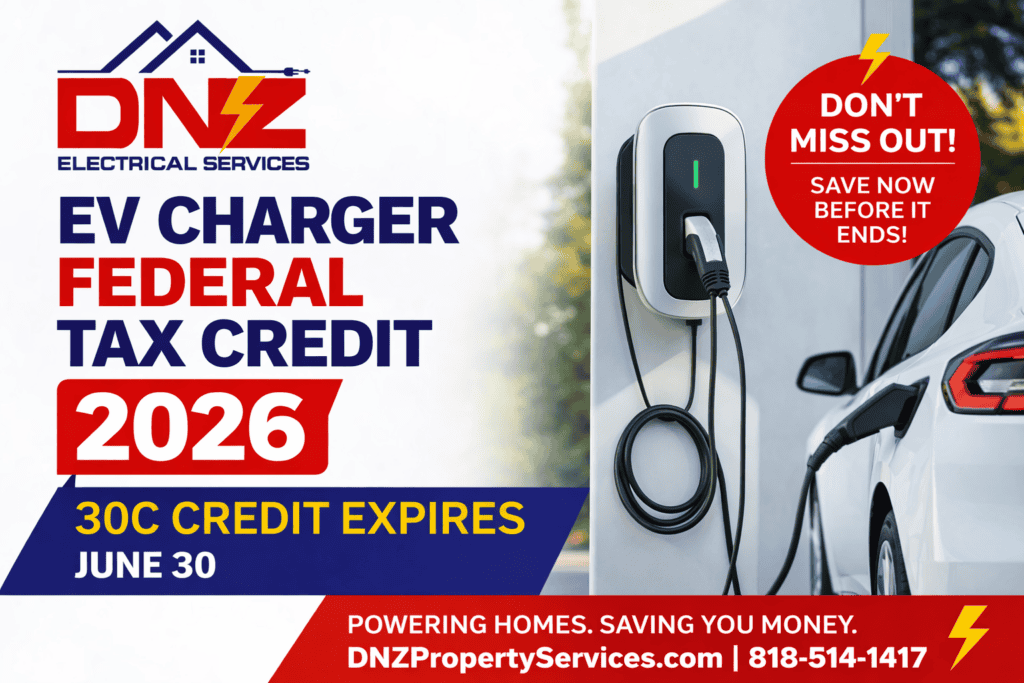
⚠️ THE DEADLINE IS JUNE 30, 2026. Your EV charger must be installed and operational by this date to qualify. Not contracted. Not scheduled. Operational. DNZ Electrical Services is already booking May and June.
Quick answer — what is the 30C EV charger tax credit?
The 30C Alternative Fuel Vehicle Refueling Property Credit is a federal tax credit that covers 30% of your EV charger installation cost up to a maximum of $1,000 for residential homeowners. It applies to both the charger hardware and the professional installation labor and permit fees. It was extended by the 2022 Inflation Reduction Act but was then moved up to expire on June 30, 2026 by the One Big Beautiful Bill signed into law on July 4, 2025.
There is one critical eligibility requirement that most homeowners do not know about: your home must be located in an eligible census tract — either a low-income community or a non-urban area as defined by the IRS. Approximately two-thirds of Americans qualify based on their address location. Whether you qualify depends on where you live, not how much you earn
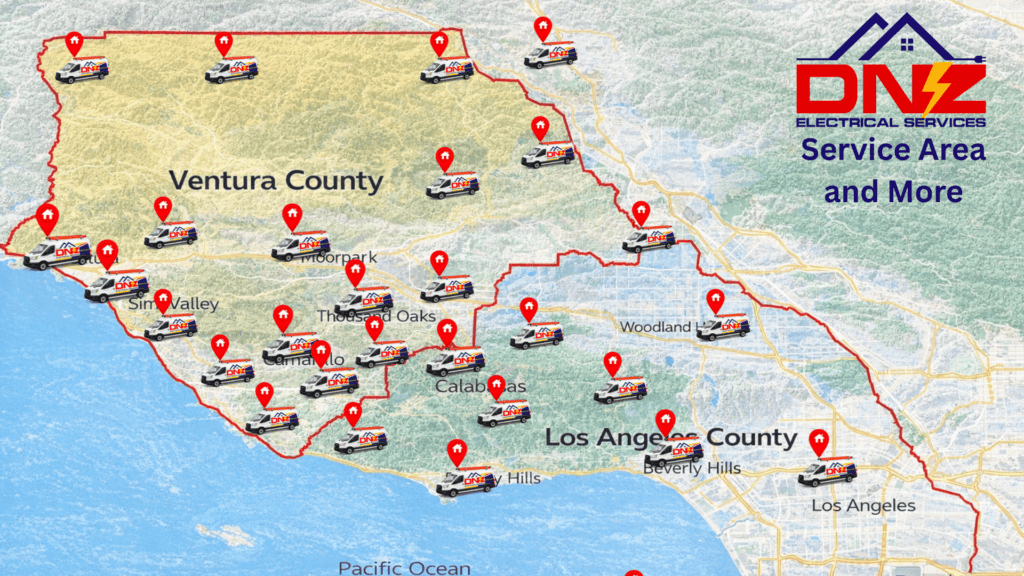
DNZ Electrical Services is an SCE Approved Contractor and EVITP certified EV charger installer. CA License #1010883. Serving Thousand Oaks, Agoura Hills, Calabasas, Westlake Village, Moorpark, Malibu, and all of LA and Ventura County.
The four things every homeowner needs to know about the 30C credit
Thing 1 : The deadline is June 30, 2026 and it is a placed-in-service date
The most important thing to understand about the 30C deadline is what it actually measures. The IRS requires the EV charger to be placed in service by June 30, 2026. Placed in service means installed and operational — not contracted, not ordered, not scheduled. If your permit is pulled on June 29 but the charger is not inspected and operational until July 5, you do not qualify.
In Thousand Oaks, Agoura Hills, and surrounding cities, a typical EV charger installation follows this timeline from first call to operational:
- Day 1 — Call DNZ, schedule assessment
- Day 2 to 3 — Assessment visit, DNZ quotes the job
- Day 3 to 7 — DNZ pulls permit with your city
- Day 7 to 14 — Permit approved
- Day 14 to 16 — Installation day, charger operational
- Day 16 to 21 — City inspection completed
⚠️ A homeowner who calls DNZ on June 20 cannot guarantee their installation will be operational by June 30. DNZ's last realistic call date for a June 30 qualified installation is approximately May 30 : allowing 30 days for the full permit-to-inspection cycle. Call 818-514-1417 today.
Thing 2 — You must be in an eligible census tract — check your address
This is the requirement most homeowners miss. The 30C credit is NOT available to every homeowner. Your home must be located in a census tract that qualifies as either a low-income community or a non-urban area as defined by the IRS.
Low-income community census tracts are areas where the poverty rate is at least 20% or median family income is below 80% of the area median. Non-urban census tracts are areas not located within an urbanized area as defined by the U.S. Census Bureau — this includes rural and semi-rural areas.
For the Conejo Valley and greater LA and Ventura County area:
- Parts of Moorpark — some census tracts may qualify as low-income based on local median income data
- Rural canyon areas of Malibu — Trancas Canyon, Encinal Canyon, Las Virgenes Road corridor may qualify as non-urban
- Parts of the eastern Ventura County cities — some qualifying tracts exist
- Most of Thousand Oaks, Agoura Hills, Calabasas, and Westlake Village — these are largely affluent urban/suburban areas that likely do NOT qualify for most census tracts
📍 CHECK YOUR ADDRESS BEFORE ASSUMING YOU QUALIFY. Use the Argonne National Laboratory 30C Tax Credit Eligibility Mapping Tool to confirm your census tract status. Your eligibility is determined by your address, not your income.Check your address: 30C Tax Credit Eligibility Locator →
Thing 3 : What costs the credit covers
The 30C credit applies to 30% of the total cost of a single EV charger installation including:
- The EV charger hardware itself (Level 2 charging unit, charging port, connector)
- Wall mount or pedestal directly supporting the charging port
- Electrical wiring and conduit dedicated to the charger
- New circuit breaker dedicated to the charger
- Panel upgrade costs IF the upgrade was required solely to support the EV charger — this is a significant point covered below
- Labor costs for installation
- Permit fees
What is NOT separately creditable:
- General panel upgrades that serve purposes beyond the EV charger
- Existing wiring that was not specifically installed for the charger
✅ KEY FACT from the IRS: If you install a new electric panel AND conduit/wiring solely to service the charger, those costs are included in the credit calculation. Per the IRS example: a homeowner who pays $1,500 for the charger itself plus $1,000 for a new panel and wiring dedicated to the charger has a total qualifying cost of $2,500 — and their credit is 30% of $2,500 = $750. DNZ provides an itemized receipt that separates these costs correctly for IRS Form 8911.
Thing 4 — The credit is non-refundable and must be filed on your 2026 tax return
Non-refundable means the credit can only reduce your federal tax liability — it cannot generate a refund. If you owe $800 in federal taxes and your calculated credit is $1,000, you reduce your tax bill to zero but do not receive the remaining $200 back.
You claim the credit on your 2026 federal tax return using IRS Form 8911 — because the charger will be placed in service in 2026. Even if you had the charger ordered in December 2025, if it is installed and operational in 2026, you file it on your 2026 return. You cannot claim it on your 2025 return.
Consult a licensed tax professional
How to claim the 30C federal EV charger tax credit
Claiming the 30C credit requires five steps. DNZ handles steps 1 through 3 on your behalf:
- Verify your address is in an eligible census tract using the Argonne National Lab tool at anl.gov/esia/refueling-infrastructure-tax-credit — check this before scheduling installation
- Schedule your EV charger installation with DNZ Electrical Services by May 30, 2026 at the latest to allow sufficient time for the permit and inspection cycle before the June 30 deadline. Call 818-514-1417.
- DNZ installs your EV charger, pulls the permit, and coordinates the city inspection. DNZ provides you with: (a) an itemized invoice separating hardware, labor, and permit costs; (b) the permit number from your city; (c) the installation date and inspection date for your records.EV charger installation cost guide
- File IRS Form 8911 (Alternative Fuel Vehicle Refueling Property Credit) with your 2026 federal tax return. The form requires: your census tract GEOID (from the Argonne tool), the cost of the charger hardware and installation, the permit number, and the placed-in-service date.
- Consult your tax professional for guidance on how the credit applies to your specific tax situation. The 30C credit is non-refundable — it reduces federal taxes owed, not generates a refund.
📝 DOCUMENTATION DNZ PROVIDES: Itemized receipt separating charger hardware, dedicated wiring and conduit, permit fees, and installation labor · City permit number · Installation date · Inspection completion date. This documentation is sufficient for IRS Form 8911. Keep all receipts and documentation for your records.
Why the 30C EV charger credit is expiring June 30, 2026 — not December 31, 2032
The 2022 Inflation Reduction Act had extended the 30C EV charger tax credit through December 31, 2032. Many homeowners and even some electricians are still operating on the old December 2032 deadline. That deadline no longer applies.
On July 4, 2025, President Trump signed into law the One Big Beautiful Bill Act. This legislation accelerated the expiration of multiple clean energy tax incentives, moving the 30C EV charger credit deadline from December 31, 2032 to June 30, 2026. The federal EV vehicle purchase credit was simultaneously ended for vehicles acquired after September 30, 2025.
The new June 30, 2026 deadline is a hard cutoff. The charger must be placed in service — installed and operational — by that date. No extensions are currently scheduled or expected.
⚠️ If someone told you the EV charger tax credit lasts until 2032 — that information is now outdated. The new deadline is June 30, 2026. Do not delay your installation based on the old deadline.
Why working with DNZ maximizes your 30C credit and SCE rebate
- DNZ is an SCE Approved Contractor — we handle the Charge Ready Home rebate application that reduces your panel upgrade cost by up to $4,200, which is the program that stacks with the 30C credit for the largest combined savings
- DNZ provides properly itemized receipts — we separate hardware, dedicated wiring and conduit, permit fees, and installation labor on every invoice. This is the documentation IRS Form 8911 requires. Many electricians provide a single combined invoice that creates problems at tax time.
- DNZ pulls all permits and coordinates all inspections — the permit number and inspection date are required for IRS Form 8911. DNZ provides both.
- EVITP certified — the EV-specific credential that qualifies DNZ to perform compliant EV charger installations
- DNZ knows the placement-in-service requirement — we plan your installation timeline with the June 30 operational deadline in mind, not just the scheduling date
- DNZ serves Thousand Oaks, Agoura Hills, Calabasas, Westlake Village, Moorpark, Malibu, and all of LA and Ventura County — we pull permits in every relevant jurisdiction
- CA License B and C10, number 1010883 — a permitted and licensed installation is required for the 30C credit
✅ DNZ's itemized receipt format is specifically structured to support IRS Form 8911 filing. Every Conejo Valley homeowner who works with DNZ gets the documentation they need to claim the full credit without ambiguity at tax time.
Cities we serve
Our shop is at 5627 Kanan Rd, Agoura Hills — right in the middle of the Conejo Valley. We cover most of LA County and Ventura County, including the cities below
- Thousand Oaks
- Agoura Hills
- Calabasas
- Westlake Village
- Moorpark
- Oak Park
- Simi Valley
- Van Nuys
- Canoga Park
- Camarillo
- Ventura
- Oxnard
- Malibu
- Woodland Hills
- West Hills
- Chatsworth
- Northridge
- Encino
Not sure if we cover your area? Check our Service Area Page or Call or Text 818-514-1417. We'll tell you straight

Frequently asked questions about the 30C EV charger tax credit
Q: Does everyone qualify for the 30C EV charger federal tax credit?
No. The 30C credit requires your home to be located in an eligible census tract — either a low-income community or a non-urban area as defined by the IRS. Approximately two-thirds of Americans live in qualifying census tracts. Many affluent suburban areas do not qualify. Check your specific address using the Argonne National Laboratory 30C Tax Credit Eligibility Mapping Tool at anl.gov/esia/refueling-infrastructure-tax-credit before scheduling your installation. Eligibility is based on your address location, not your income.
Q: If I don't qualify for the 30C credit, are there other rebates available?
Yes. The SCE Charge Ready Home rebate does not have a census tract requirement. All Southern California Edison customers in the SCE service territory qualify to apply for up to $4,200 toward electrical panel upgrade costs. DNZ Electrical Services is an SCE Approved Contractor and handles the full application on your behalf. Call 818-514-1417.
Q: Is the 30C credit based on my income?
No. The 30C credit eligibility is based on your home's address location — specifically your census tract — not your income. A high-income homeowner in a qualifying rural or low-income census tract is just as eligible as a lower-income homeowner in the same area. Conversely, a lower-income homeowner in a non-qualifying affluent suburban census tract is not eligible regardless of their income. Check your address at anl.gov/esia/refueling-infrastructure-tax-credit.
Q: When exactly does the 30C EV charger tax credit expire?
The 30C Alternative Fuel Vehicle Refueling Property Credit expires June 30, 2026. Your EV charger must be placed in service — installed and operational — by that date. Not contracted, not ordered, not scheduled. Operational. The One Big Beautiful Bill signed into law on July 4, 2025 moved the deadline forward from the original December 31, 2032 expiration date. No extensions are currently scheduled.
Q: When is the last day I can call DNZ to guarantee my installation qualifies?
For a standard Level 2 EV charger installation, DNZ recommends calling by May 25 to 30, 2026 to allow sufficient time for permit approval, installation, and city inspection before the June 30 deadline. For a combined panel upgrade and EV charger project, call by May 10 to 15. DNZ will be honest with you about whether your specific project can be completed by June 30 when you call. Call 818-514-1417 today to avoid cutting it close.
Q: My EV charger was installed in late 2025 — can I claim the 30C credit?
Yes, if your address was in an eligible census tract at the time of installation. Claim the credit on your 2025 federal tax return using IRS Form 8911. The credit applies to installations placed in service from January 1, 2023 through June 30, 2026. If you have not yet filed your 2025 return and your charger was installed and operational in 2025, consult your tax professional about claiming it on your 2025 return.
Q: Does the 30C credit cover the EV charger hardware or just the installation?
Both. The 30C credit covers 30% of the total cost including the EV charger hardware (charging port, connector, and directly supporting equipment), dedicated wiring and conduit, dedicated circuit breaker, panel upgrade costs if the panel was upgraded solely to support the charger, installation labor, and permit fees. The maximum credit for residential homeowners is $1,000. DNZ provides an itemized receipt that separates each cost component for IRS Form 8911 filing.
Q: What is IRS Form 8911 and how do I file it?
IRS Form 8911 is the Alternative Fuel Vehicle Refueling Property Credit form used to claim the 30C credit on your federal tax return. You file it with your tax return for the year the EV charger was placed in service. You will need: the cost of the charger hardware and associated installation costs, the permit number from your city, the installation date, and your census tract GEOID from the Argonne National Lab mapping tool. DNZ Electrical Services provides all installation documentation. Consult your tax professional for guidance specific to your situation.